Showing posts with label poetry. Show all posts

Wednesday, October 15, 2014

Snowballing

A Snowball is a poem in which each line is a single word, and each successive word is one letter longer. If you're metrophobic, try writing a sentence. Though poetry might be easier since it doesn't need to make as much sense ;-)

I
go
now
into
under
ground
tunnels
carrying
bodacious
starstruck
jackrabbits
backflipping

Two sites that list words by length are Your Dictionary and Best Word Lists.


If you would like to see a prolific snowballer in action, check out Snowball Poetry on Twitter. (The beginning of mine came from one there.)

Snowball was created by the Oulipo (Workshop of Potential Literature). They gather together to create constrained writing challenges. It's also called a chaterism which Wikipedia defines as "where the length of words in a phrase or sentence increases or decreases in a uniform, mathematical way." (I'm guessing since snowballs get bigger when rolled, the word originally referred to poems with words that increased. Chaterism is a broader concept.)

There is a Snowball Poetry Generator for Windows.

Friday, February 21, 2014

Supernatural writing prompts from LitBridge

What a wonderful collection of story and poetry prompts at LitBridge about the supernatural (and mundane) world. The site is dedicated to helping writers of all levels become more professional with information about writing programs, contests and more.

On the writing prompts page, are links organized by a huge collection of categories from seasons, to mythological creatures, to beautiful words. Each page has 10-30 prompts. The collection the supernatural links below were taken from is about halfway down the page.

Creative Writing Prompts About Aliens
Creative Writing Prompts About Demons
Creative Writing Prompts About Dragons
Creative Writing Prompts About Dreams
Creative Writing Prompts About Fairies 
Creative Writing Prompts About The Future
Creative Writing Prompts About Gargoyles
Creative Writing Prompts About Ghosts
Creative Writing Prompts About Heaven
Creative Writing Prompts About Hell
Creative Writing Prompts About Mermaids
Creative Writing Prompts About Superheroes
Creative Writing Prompts About Werewolves
Creative Writing Prompts About Vampires
Creative Writing Prompts About Zombies
What If Creative Writing Prompts

Here's a sampling:

Write a story about a man who virtually chats with an alien unknowingly. The man starts to fall in love with this mysterious stranger. What happens next?

Write a poem about yourself from the perspective of an alien.

Write a story about different dragons from varying cultures meeting each other. Try to research how different cultures perceive dragons to better give your dragons more realistic and culturally appropriate attitudes.

Write a poem about how to care for a dragon.

Write a story about a demon who wants to become good but faces resistance from fellow demons.

Write a story about a baby demon who is learning to help humans sin, possess their bodies and ultimately take their souls.

Write a story from a perspective of a main character who is looking for a dream. Why is he or she looking for a dream? What happened to their prior dreams? Describe the journey.

Write a poem about alternative views of fairies such as them being demoted angels, having connection to death, or as another race.

Write a story about a young psychic who discovers that she has the ability to communicate with people living in the future.

Write a poem with the following words: granite, evil, aqueducts, and gargle.

Write a story about a human who wakes up as a stone gargoyle. The story could be about the people the human gargoyle sees everyday. During the story, the gargoyle may be turned back into a human. What happens next?

Write a story that is entirely based in a ghost world.

Write a poem in the form of a ghost story.

Read literature that describes what heaven is like. This literature can include various religious texts. Write a poem dedicated to each of these types of heavens. Feel free to include your own perceptions of these heavens.

Write a story where the main character has a genuine fear of spending eternity in heaven.

Write a story where the main character is trying to be recruited by Lucifer to become the Antichrist.

Write a story about mermaids who live in modern civilization and have regular jobs, schedules and responsibilities.

Write a story from the perspective of the villain who happens to be a close friend or lover of a superhero.

Write a poem about a modern or fictional superhero who has truly failed in a crisis.

Write a story that begins with a superhero’s death and how the world reacts to it.

Write a story about a child who is raised in a family of werewolves. However, he did not inherit the family trait of being a werewolf.

Write a poem about transformation. Try to use an analogy that compares transformation with the type of transformation a werewolf may have.

Write a poem with the following words: mocking, blood, fangs and immortality.

Write a poem about the relationship between vampires and religion.

Write a funny story about a character who truly believes he/she is a vampire even though he may not be one at all.

Write a story about a zombie who slowly falls in love with another zombie.

What if your friend joined a cult that worshipped dogs?

What if your pet could only talk to you at midnight for an hour?

What if you could make any religious belief truly real? Which one would you pick and why?

Wednesday, April 18, 2012

Berrylistious

Write a list poem of ice cream flavors.

A list poem will usually have an introduction and conclusion to give a reason for the list. Generally list poems don't rhyme, but the inspiration for this prompt has rhyming couplets of flavors. So try generating a list of flavors (like berry and cherry) that rhyme before enhancing them. It will help the flow and maintain interest if there's a pattern with periodic surprises. Often the last item will feel like a conclusions being particularly exceptional or tying the items together.

credit
Inspired by Jack Prelutsky's Bleezer's Ice Cream.  Bruce Lansky has written the amusing How to Write a "What Bugs Me" List Poem and How to Write "A Lunch for your Teacher" Poem for kids.

Wednesday, April 11, 2012

Lair of pines

Spoonerisms are named after William Archibald Spooner who was prone to switching the initial sounds of words. The rather poetic thing about spoonerisms is they naturally rhyme.

Create rhyming couplets using pairs of Spoonerisms, such as:

Stuffing down a ground beef,
the dumped lover bound his grief.

Here's a bunch to choose from. Or, of course, come up with your own.

buns glazing
rental deceptionist
ducky lay
hot Poles
candle with hair
blushing crow
plaster man
mad banners
a well-boiled icicle (well-oiled bicycle)
sock my knocks off
chewing doors (doing chores)
clappy as a ham
go shake a tower (take a shower)
roaring pain (pouring rain)
chilled grease
spew up your screech
as the flow cries
bound grief
sues and shocks
brunch lake
shoving leopard
fighting a liar
know your blows
go shake a tower
tease my ears
nicking your pose
lack of pies
roaring with pain
sealing the hick
go help me sod
pit nicking
bowel feast
damp stealer
wave the sails
mad bunny
pun fart
bunny phone
flutter by
bedding wells
mend the sail
zips are lipped
belly jeans
eye ball (bye all)
fight in your race
hiss and lear (listen hear)
soul of ballad (bowl of salad)
cattle ships and bruisers
nosey little cook (cozy little nook
tons of soil
hags flung out
half-warmed-fish

Wednesday, April 04, 2012

Poem baggery

Cut up a paper bag (phone book page, newspaper, ...) into 20 pieces of various sizes. Write 20 words on the pieces. Any 20 words. Mix them up then shuffle them into a poem. Or intriguing phrases to  use in a writing piece.

From Day 138 in The Aspiring Poet's Journal

Tuesday, April 03, 2012

30 Writing Prompts for National Poetry Month

Kelli Russell Agodon listed 30 Writing Prompts for National Poetry Month a couple of years ago. Nearly all are friendly to non-self-reflective poets. :-)

  1. Write a really ugly poem.
  2. Quickly pick out 12 words from the titles of books on a nearby bookshelf. Use them in a poem.
  3. Write a poem with an invented biography for yourself.
  4. Take a 1-2 page poem from a book and re-type it backwards—from the very last word in the poem all the way to the very first, keeping the lines the same lengths as they are in the book. Use this as the starting point of a poem, picking out the word formations that are particularly interesting to you.

More at Book of Kells blog (and in the Comments in case it disappears.)

Wednesday, January 11, 2012

Songmash

Doberman by Michel Keck
Use all the words from the lyrics of your favorite song in a story or poem.

Or try some Christmas carols. The national anthem. Other countries' national anthems. Happy Birthday. Monster Mash. Weird Al Lyrics.

Some suggestions from my daughter for science fiction and fantasy subjects. (The Vikings and Trolls are kinda loud so you may want to ease your speakers into them ;-)


If you'd like a list, paste the lyrics from the internet into a word processor. (Some sites are getting cagey about copying so it might take a few tries.) Replace all the spaces with carriage returns. Strip out the punctuation. Then paste the lyrics into Alphabetizer. It will remove the duplicates and sort them or randomize them for you.


Tuesday, May 03, 2011

Steal this rhyme scheme

Sculpture by Jason Freeny

Okay, one more! I had an extra sonnet idea but ran out of days in April. 

Steal a rhyme scheme from a sonnet and create your own poem around it.

Another possibility is to come up with 7 rhyming pairs. And then work the sonnet around them.

Here are some rhymes stolen from Shakespeare. I eliminated words that were archaic and most of the ones where the words no longer rhymed. As usual I ended up with too many! So there are four collections here and a bunch more if you click on Comments.

Helen Hayes relates in her memoir that she got rid of her southern drawl by reciting Shakespeare's sonnets.

If you'd like to browse through on your own, the full collection, all on one page, is at Shakespeare Sonnets. If you'd prefer to steal from modern sonnets, try Sonnets.org.

time
wights
rhyme
knights
best
brow
express'd
now
prophecies
prefiguring
eyes
sing
days
praise

possessing
estimate
releasing
determinate
granting
deserving
wanting
swerving
knowing
mistaking
growing
making
flatter
matter

paws
brood
jaws
blood
fleets
time
sweets
crime
brow
pen
allow
men
wrong
young

dead
bell
fled
dwell
not
so
forgot
woe
verse
clay
rehearse
decay
moan
gone

Thursday, April 28, 2011

Stonnets

More fun with the sonnet form: Stonnets! Stories retold in sonnet form. If you want to turn the story into the character's thoughts on why they did what they did to keep the argument aspect of the sonnet, go for it :-) Or if you want to play around with the mechanics, you can rework the story into the rhyme scheme and meter of the 14 line sonnet form.

Try a fairy tale, nursery rhyme, favorite story from history, movies, books.

When you're done, Graeme King has played with the form to create a bunch of them at Funny Sonnets at Kingpoetry. (Where there are funny poems of many different forms, too.)

Tuesday, April 26, 2011

The cool thing about sonnets


Ignore the rhythm and rhyme of a sonnet? In The Handbook of Poetic Forms, Ron Padgett suggests you do exactly that to get started writing them. Because there's a more interesting aspect of (English or Shakespearean) sonnets that's often left out of the descriptions: they're an evolving argument with a punch line.

(Padgett suggests after you get used to the unfolding pattern of thought, then work in rhythm and rhyme. Which is: 14 lines rhyming abab cdcd efef gg with each line having 10 syllables of alternating stress: ba DUM ba DUM ba DUM ba DUM ba DUM.)
  • First set of 4 lines, the speaker sets up an idea.
  • Second set of 4 lines, the speaker explores it further.
  • Third set of 4 lines, there's a larger or new view of the idea. There's a turn in the speaker's thinking for a twist or conflict or emotional or mood shift. Quite literally the 4 lines may begin with But. (Here's some that Shakespeare used: so, yet, but, because, now, ah!, o!, never, for, alas!, thus, no, therefore, then, why.) "The speaker stops presenting evidence and starts to draw a conclusion from the evidence."
  • Last set of 2 lines, there's another turn, and the poet draws a (sometimes surprising) conclusion. It can sometimes feel like a punch line.
In short:
Here's what and why.
Here's some more why.
But wait.
Ah ha!
Of course you don't need to be serious! You can argue why, despite many negatives, you'll still spend the extra money on Starbucks, or why you like the older chapters of Star Wars, or find cats superior to dogs.

As an example, Shakespeare's oft quoted sonnet that begins "Shall I compare thee to a summer's day?" (#18) can be summarized as:
Here's why I shouldn't compare you to a summer's day.
All beautiful things fade.
But your beauty won't.
Because people will keep my poetry alive down the ages and give your beauty immortality.
Original side by side with modern English
Detailed analysis

And "When my love swears that she is made of truth" (#138).
Even though I know my mistress lies, I believe her and project the illusion of being an inexperienced youth.
Even though she knows I'm old, she believes me young and both of us willingly suppress the truth.
But why don't we tell the truth?
Because believing the lies helps us ignore each other's faults.

Friday, April 22, 2011

Thursday, April 21, 2011

Love me not

Today, write a poem or prose piece with the word love in it several times. But make it not a love poem or piece.

Inspired by Day 208 in The Aspiring Poet's Journal by Bernard Friot.

Wednesday, April 20, 2011

Tuesday, April 19, 2011

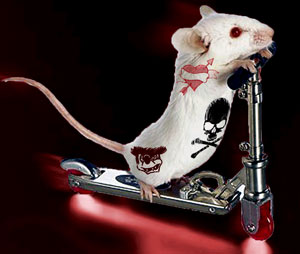
A tattooed mouse

There was a crooked man,
and he walked a crooked mile,
He found a crooked sixpence
upon a crooked stile.
He bought a crooked cat
which caught a crooked mouse,
And they all lived together
in a little crooked house.

Use that form as inspiration. What about a purple ghost? Or a tattooed mouse? A spotted dick? (Which is a pudding in England.) A dark black charm? A faceless clown?

Change as much of the content as you want. Can you make it work with a one syllable adjective and two syllable noun? Do you need to keep the dah-dah-DAH rhythm pattern or would a crabby werewolf work? Try tapping it out. Or jumping rope to it. :-)

Monday, April 18, 2011