
Showing posts with label cats. Show all posts
Showing posts with label cats. Show all posts
Sunday, September 16, 2012


Wednesday, October 05, 2011
Camo kittehs


Camo kittehs.
Theyz in ur hous. Hidin in plain sites. Watchin yuz.
What is their purpose? Why are they undercover? Have they integrated into every home in the world? Or is that their long range plan?
Are they chameleons or do they need to seek out a home with a spot compatible with their fur?


Wednesday, July 27, 2011
Y?
 |
| Photo from Wikipedia |

- cry
- crypt
- fly
- gypsy
- hymn (song praising someone or something, most familiarly the Christian God but can be any deity)
- lymph (can also mean pure water in addition to the clear liquid in blood)
- lynch
- lynx
- myrrh
- myth
- nymph
- pry
- pygmy
- rhythm
- scry (predict the future with a crystal ball)
- shy
- sly
- spy
- sphynx (hairless cat breed)
- spry
- sync
- tryst
- wyrm (a dragon without legs)
- syzygy
- by
- my
- dry
- fry
- gym
- ply
- sky
- sty
- try
- why
- wry
There are more words at List of words in English without vowels but most are pretty odd, obscure or specialized (like srsly in text-speak). The page is part of a larger collection of English words with uncommon properties, like words with alternating consonants and vowels (honorificabilitudinitatibus for instance), q not followed by u (which gets its own whole page!), kangaroo words (words that contain the letters in the right order of a similar word like masculine/male, observe/see), pyramid words (where one letter appears once, another letter twice, another three times, like banana and sleeveless).
Wednesday, June 08, 2011
Oh, noes!

I love creating the prompts so to continue, I'll slow down to one regular prompt a week. It won't be forever! But it will be for a while :-(
Tuesday, December 08, 2009
Rhopalic

Dmitri Borgmann wrote a rhopalic sentence up to 20 letters: "I do not know where family doctors acquired illegibly perplexing handwriting; nevertheless, extraordinary pharmaceutical intellectuality, counterbalancing indecipherability, transcendentalises intercommunications' incomprehensibleness."
If you'd like to try your hand at writing a rhopalic headline, Anu Garg of A Word a Day is running a contest that ends this Friday. The headlines submitted can be real or imaginary, can be increasing or decreasing word lengths.
Anu Garg has posted the best entries at his website: Rhopalic headline contest.
Alternatively, how far can you get on a rhopalic alliterative alphabet before going nuts? ;-)
Thursday, June 25, 2009
Humoresque
Hippocrates believed moods and behaviors were caused by the balance of four bodily fluids (called humors): blood, yellow bile, black bile, phlegm. During the Renaissance, Shakespeare and other authors based characters on the four humors or temperaments. It's good to have a balance in real life, but for characters it's good to be unbalanced :-)
Come up with some characters based on the four humors. Set them in a situation together and see what happens.
 Sanguine (blood, cheerful)
 Choleric (yellow bile, enthusiastic)
 Melancholic (black bile, somber)
 Phlegmatic (phlegm, calm)
There's a chart that categorizes the traits and strengths and weaknesses of each:
If you'd like to see the mixture of humors in your character (or yourself) there's a personality test.
The Divided Kingdom by Rupert Thomson is about a world where people are isolated into quarters by personality type. I'm seeing some inherent conflict there in a land filled with leaders but no followers and thinkers but no doers.
Come up with some characters based on the four humors. Set them in a situation together and see what happens.
 Sanguine (blood, cheerful)
A sanguine person is generally light-hearted, fun-loving, a people person, loves to entertain, spontaneous, leadership abilities, and confident. However they can be arrogant, cocky, and indulgent. They can be day-dreamy and off-task to the point of not accomplishing anything and can be impulsive, possibly acting on whims in an unpredictable fashion.
The temperament is associated with the season of spring, the qualities of warm and moist, the element of air. Various modern equivalents are: artisan, improvisor, artistic, innovative, changeable.
Synonyms: cheerful, confident, optimistic, assured, hopeful, buoyant, in good heart
 Choleric (yellow bile, enthusiastic)
A choleric person is a doer. They have a lot of ambition, energy, and passion, and try to instill it in others. They can dominate people of other temperaments, especially phlegmatic types. Many great charismatic military and political figures were cholerics. On the negative side, they are easily angered, bad-tempered, mean-spirited, suspicious and angry.
The temperament is associated with the season of summer, the qualities of warm and dry, and the element of fire. Various modern equivalents are: idealist, catalyst, religious, doctrinaire, inspired.
Synonyms: irate, testy, hot-tempered, fiery, irritable, quarrelsome
 Melancholic (black bile, somber)
A melancholic person is a thoughtful ponderer. Often very kind and considerate, melancholics can be highly creative – as in poetry and art - but can become overly pre-occupied with the tragedy and cruelty in the world, thus becoming depressed. A melancholic is also often a perfectionist. This often results in being unsatisfied with one's own artistic or creative works and always pointing out to themselves what could and should be improved.
The temperament is associated with the season of autumn, the qualities of cold and dry, and the element of earth. Various modern equivalents are: guardian, stabilizer, economic, traditional, industrious.
Synonyms: languid, spiritless, gloomy

A phlegmatic person is calm and unemotional. While phlegmatics are generally self-content and kind, their shy personality can often inhibit enthusiasm in others and make themselves lazy and resistant to change. They are very consistent, relaxed, rational, curious, and observant, making them good administrators and diplomats. Like the sanguine personality, the phlegmatic has many friends. However the phlegmatic is more reliable and compassionate; these characteristics typically make the phlegmatic a more dependable friend.
The temperament is associated with the season of winter, the qualities of cold and moist, and the element of water. Various modern equivalents are: rational, theorist, theoretic, skeptical, curious.
Synonyms: unemotional, indifferent, cold, heavy, dull, sluggish, matter-of-fact, placid, stoical, lethargic, bovine, apathetic, frigid, lymphatic, listless, impassive, stolid, unfeeling, undemonstrative
There's a chart that categorizes the traits and strengths and weaknesses of each:
If you'd like to see the mixture of humors in your character (or yourself) there's a personality test.
The Divided Kingdom by Rupert Thomson is about a world where people are isolated into quarters by personality type. I'm seeing some inherent conflict there in a land filled with leaders but no followers and thinkers but no doers.
Tuesday, November 13, 2007
Kitten Dream
 Here's something Kat stumbled across and has anxiously been waiting for the owners to do something with the website. (She just loves anything to do with cute kitties!) It's the Chinese website for Kitten Dream, a cast of characters who appear in comics (manhua) and animation and lots of merchandise.
There are several 7 page and 20 page comics written in Chinese. The challenge today is to write English words that would fit the story. (Not translating. Just coming up with your own words.) What's interesting is how much you can get of the story just from the pictures. Note: the panels read right to left, but the pages for "7 page" stories are arranged left to right -- just to confuse you more! :-)
Here's the cast of characters (in English) if you want to use their names or get some hints about their personalities.
The "7 page" comics (though apparently they're only 4 pages long??) load quickly and the whole (very simple) story appears all on one screen.
The 20 page comics take a while to load (even with high speed internet) with one page per screen but the stories are a bit more complex. (Though we're not talking Shakespeare here ;-) You'll be able to pick up what's going on by looking at the pictures!)
(Some of the site has been translated into English but not the comics yet. The English link is in the upper right corner.)
Thursday, July 12, 2007
Cat trap
 Explain what led up to this. Or what came after.
(Click for a larger view.)
(No cats were harmed in the making of the picture! Just their pixels in Photoshop.)
Tuesday, June 19, 2007
Obfuscated polysyllabic philosophies
 Turn the following common proverbs into obfuscated polysyllabic philosophies.
Here's a couple of examples:
Who sums the yet unfractured shells of bipeds gallinaceousYou don't need to make them rhyme ... but you can if you'd like!
Is apt to find his calculations woefully fallacious.
A futile superfluity of culinary aid
Will mar the gastronomic juice of osseous tissue made.
- A bird in the hand is worth two in the bush.
- Beggars can't be choosers.
- Do unto others as you would have them do unto you.
- Haste makes waste.
- If you can't beat them, join them.
- Let the cat out of the bag.
- Money doesn't grow on trees.
- Necessity is the mother of invention.
- Quality is better than quantity.
- The pen is mightier than the sword.
- Where there's smoke, there's fire.
- You can't have your cake and eat it too.
Tuesday, June 05, 2007
Cats and snakes
 Describe a cat fight (with another cat, with its prey, with an attacker) in snake terms. Try to work in as many terms you'd use to describe snake appearance, behavior, attitude into the description.
(Feel free to substitute other creatures but make one of the animals familiar.)
Thursday, May 03, 2007
"No!"
 This is from an exercise in Unjournaling. Write 10 sentences that say no without using the word "no". Or, come up with a scenario where one character must repeatedly say no -- but doesn't use the word no -- to the other character.
Here's the scenario Kat came up with that you may use if you wish: Tiger and Star, two cat people, are arguing. Tiger -- who believes that Martians are real -- wants to burn Star's collection of Prince Fielder (1st Base, Milwaukee Brewers) baseball cards because the cards will bring the Martians to invade.
Write a conversation between Tiger, who is begging and trying to persuade, and Star, who is saying no. Have Star tell Tiger "No," but without using the word "no" at least 10 times.
Adapted from Unjournaling: Daily writing exercises that are Not personal, Not introspective, Not boring! by Dawn DiPrince and Cheryl Miller Thurston. It has a lot of fun writing prompts that live up to the title :-)
Thursday, April 26, 2007
The third eye
 For the poetry warm up today, use the template: "The third eye can see ..."
The third eye can see what regular eyes can't or is only open when the regular eyes are closed.
Here are some examples of children's poems from the book:
The third eye can see inside meFrom Wishes, Lies, and Dreams: Teaching children to write poetry by Kenneth Koch.
The third eye can see my voice
The third eye can see my bones
The third eye can see the wind
Saturday, April 21, 2007
Yaddy-Yadda Haiku
In honor of the Anime Boston convention that kept me busy all weekend and since nothing is coming to me that relates anime to poetry, the "Saturday" tip at least draws inspiration from Japan. This game was designed to play with a "Yaddy-Yadda" card deck. It's no longer available (or temporarily unavailable) but you could substitute Scrabble tiles. Or write the alphabet on slips of paper. You may want to add extras of S, P, C, D, M, and A since those letters start the most words.
 For 3 or more players
To play this game, you need a Yaddy-Yadda Deck as well as pencils and paper for each player.
Overview
Each player will create a haiku based on letters drawn from the Yaddy-Yadda Deck. The title of the haiku will be chosen by one player who will act as moderator. The moderator will also judge the winning haiku based on criteria given at the start of the game.
Preparing to play
Remove both X's and Z's from the deck. They won't be used in this game. Shuffle the remaining cards and place them in the middle of the table.
Next, choose a player to be the moderator for the game. Her role will be to choose a title and the criteria for judging a winning haiku. After all other players have written their haikus, she will also pick the winning poem.
A haiku in this game
The definition of a haiku will be in very general terms for purposes of these rules. Here, a haiku will consist of a title and three lines. The first and third lines will have five syllables each. The second line will have seven syllables.
Here's a simple example from one of our games:
Playing the game
First the moderator will turn over the top two cards of the deck. These two letters must be used to form a title for the haiku each player will write. There must be a word in the title that begins with each of the two letters just revealed. In the above example, an "D" and "C" were revealed giving way to the title "Cold Day". The order in which the moderator uses the letters is irrelevant. Also, there can be more than two words in the title, with other words beginning with any letter. However, it's best to keep titles very simple for this game. Players should write the title of the haiku at the top of their papers at this time.
After the moderator chooses a title, she then must tell players the criteria she will use to judge the winning haiku. As examples, she may judge haikus based on...
Next, the moderator turns up three pairs of letter cards from the deck onto the table. Each pair should be arranged in a separate row, so that players can easily see which letters are paired up. Each of these pairs of letters will be used to begin words in each line of the haiku. For example, if the first pair of letters was "H" and "M", the first line of each haiku must have a word that begins with an "H" and one that begins with an "M". As with the title, the order of these words in the haiku is irrelevant. So, given this example, a player could write "My hands shake with cold" or "A hundred or more-". The second pair of letters will be used for words in the second line and likewise with the third. Back to the "Cold Day" example above, the letters we had to work with are highlighted:
When everyone is done, the haikus are passed to one player (other than the moderator) who will read each aloud. If the moderator chose to write one herself, she can begin by reading hers. Then the player reads each haiku to the moderator. She may request that any be repeated as often as necessary to make a judgement. Her judgement as to the best haiku is final, but a winning haiku should at least relate to the title given at the start of the game and it must follow the rules above regarding syllables and the use of the letters on the Yaddy-Yadda cards.
Further games
The game can be repeated any number of times. If each player is moderator once, an overall winner may be determined by keeping track of who wins each game. It's likely several players may tie for victory in this case, but I hope it's clear winning isn't the only enjoyable goal of this game.
Players may choose to vary the poetry in many ways. Instead of writing only haikus, poems of any type can be created as the moderator chooses. Since words are chosen based on letter cards, the maximum length of the poem will always be dictated by the moderator. Game time, of course, becomes a major factor with longer poems. The moderator may create a rhyme scheme the players have to follow, or that may be left up to the individual players.
Yaddy-Yadda Haiku
For 3 or more playersTo play this game, you need a Yaddy-Yadda Deck as well as pencils and paper for each player.
Overview
Each player will create a haiku based on letters drawn from the Yaddy-Yadda Deck. The title of the haiku will be chosen by one player who will act as moderator. The moderator will also judge the winning haiku based on criteria given at the start of the game.
Preparing to play
Remove both X's and Z's from the deck. They won't be used in this game. Shuffle the remaining cards and place them in the middle of the table.
Next, choose a player to be the moderator for the game. Her role will be to choose a title and the criteria for judging a winning haiku. After all other players have written their haikus, she will also pick the winning poem.
A haiku in this game
The definition of a haiku will be in very general terms for purposes of these rules. Here, a haiku will consist of a title and three lines. The first and third lines will have five syllables each. The second line will have seven syllables.
Here's a simple example from one of our games:
Cold DayTraditionally, the haiku is simple, dealing with ordinary life and seasons of the year. A moderator may always give a more specific definition of a good haiku for any session. A brief introduction to the art of the haiku can be found here.
Under my blanket
I keep warm in pajamas
It's freezing outside
Playing the game
First the moderator will turn over the top two cards of the deck. These two letters must be used to form a title for the haiku each player will write. There must be a word in the title that begins with each of the two letters just revealed. In the above example, an "D" and "C" were revealed giving way to the title "Cold Day". The order in which the moderator uses the letters is irrelevant. Also, there can be more than two words in the title, with other words beginning with any letter. However, it's best to keep titles very simple for this game. Players should write the title of the haiku at the top of their papers at this time.
After the moderator chooses a title, she then must tell players the criteria she will use to judge the winning haiku. As examples, she may judge haikus based on...
- originality
- humor
- aesthetic value (possibly further clarified)
- relation to title
Next, the moderator turns up three pairs of letter cards from the deck onto the table. Each pair should be arranged in a separate row, so that players can easily see which letters are paired up. Each of these pairs of letters will be used to begin words in each line of the haiku. For example, if the first pair of letters was "H" and "M", the first line of each haiku must have a word that begins with an "H" and one that begins with an "M". As with the title, the order of these words in the haiku is irrelevant. So, given this example, a player could write "My hands shake with cold" or "A hundred or more-". The second pair of letters will be used for words in the second line and likewise with the third. Back to the "Cold Day" example above, the letters we had to work with are highlighted:
Under my blanketAt this time, players work on their individual haikus until everyone is finished. While the moderator can't make and judge her own haiku, she may choose to make one that would represent the criteria she chose for the game.
I keep warm in pajamas
It's freezing outside
When everyone is done, the haikus are passed to one player (other than the moderator) who will read each aloud. If the moderator chose to write one herself, she can begin by reading hers. Then the player reads each haiku to the moderator. She may request that any be repeated as often as necessary to make a judgement. Her judgement as to the best haiku is final, but a winning haiku should at least relate to the title given at the start of the game and it must follow the rules above regarding syllables and the use of the letters on the Yaddy-Yadda cards.
Further games
The game can be repeated any number of times. If each player is moderator once, an overall winner may be determined by keeping track of who wins each game. It's likely several players may tie for victory in this case, but I hope it's clear winning isn't the only enjoyable goal of this game.
Players may choose to vary the poetry in many ways. Instead of writing only haikus, poems of any type can be created as the moderator chooses. Since words are chosen based on letter cards, the maximum length of the poem will always be dictated by the moderator. Game time, of course, becomes a major factor with longer poems. The moderator may create a rhyme scheme the players have to follow, or that may be left up to the individual players.
Tuesday, April 10, 2007
I wish ... some more
 I should have sent this as the first warm up, but since we've had several new people join the list in the last week, it *is* the first warm up for them :-)
A poetry warm up is a template that lets you play with words without worrying about structure. It's sort of a coloring book for poetry :-)
This is a great initial warm up since it gives so much but allows for a great deal of goofy creativity.
Each line starts with "I wish" then must include a color, a fictional character and a place.
Here are some children's examples:
I wish I was green with Superman in the Negev Desert.From Wishes, Lies, and Dreams: Teaching children to write poetry by Kenneth Koch.
I wish I was Charlie Brown in blue Saudi Arabia.
I wish that I was Popeye with a yellow dress on me and in South Carolina.
I wish Bugs Bunny didn't climb the blue tree in Turkey Land.
(By the way, if you want to create your own template, you're not limited to colors and fictional characters. You can start with anything. Kenneth Koch suggested animals, months, cars, planets, drinks, birds, states ... The possibilities are as vast as your imagination :-)
Thursday, April 05, 2007
I used to ... But now ...
 Poetry warm up. Alternate these lines:
I used to ...
But now ...
Here's some examples of children's poems from the book. Children are free of preconceived notions about what they're "supposed to" write :-)
I used to be a fishFrom Wishes, Lies, and Dreams: Teaching children to write poetry by Kenneth Koch.
But now I'm a nurse
I used to be a rose
But now I'm a leaf
I used to be a design
But now I'm a tree
I used to have a baby
But now he's a dog
Saturday, March 10, 2007
Weekend 8: A break
 A break from the mystery writing.
We have the technology now: a brand new old computer. Next week we'll be working on Weekend 7 so we're a bit behind.
Saturday, March 03, 2007
It's like a ...
 This Writer's notebook idea came to me while collecting poetry ideas for Poetry Month.
Observe people and things, notice sounds, smells, and textures then write comparisons using like or as.
(The previous notebook ideas are archived at the Blogsome blog.)
Here's some quick examples I generated while at Starbucks:
slumped like a drought touched flower
chewing like a sun beaten cow
alert like a nervous cat
pony tail flat against his back like road kill
teeth clutching her lip like a clamp
pony tail like a clutch of too long sheep's wool
worrying at a nail like a cat peeling its claws
sign swaying on a corner in the wind like a drunk who has forgotten where he was headed
steaming like a teapot at a winter cafe
heavy sway of her hair like a horse's tail
hair hugging her face like a hood drawn tight
Friday, February 16, 2007
Weekend 7: Plot picture-diagram
 Seventh weekend with "Weekend Novelist Writes a Mystery".
This weekend is a plot picture-diagram.
Two things the authors mentioned this time that should have come up before:
Name your scene cards. By naming each scene you'll be able to more easily call up the package of people, revelations, objects, emotions, the scene contains. This will be a big help to you when you're trying to get an overall sense of the flow of scenes or when you shuffle them about trying to see where a scene works best. The authors suggest having fun with the names, to create vivid connections between the title and the scene. The more vivid the title, the stronger the connection and picture it will call up for you.
Act length. Acts 1 and 3 are about the same length. Act 2 is about twice as long. Since Act 2 is divided by the midpoint, Act 1, Act 2 first part, Act 2 second part and Act 3 are all about the same length. If the book is about 300 pages, Act 1 will end around page 75, the midpoint will be page 150 and the beginning of Act 3 will be around page 225. At the moment this is important, but when you start writing, if you find yourself on page 120 with no sign of the plot point that should end Act 1, that will give you a clue that things need tightened up there during your first rewrite.
Plot Pictures
So far you've generated scenes that need to be in the story, stuff that there won't be a murder mystery without: discovering the body, confronting the killer, climaxes/crises to raise the drama and so on. You also have a cast of characters who need to enter and exit the book at various points. A plot picture can help you see if characters might be tripping over each other in the beginning and no where to be seen in the middle, or that an important clue doesn't get mentioned until the end of Act 2.
Draw a rising line across the page. This represents rising drama. Divide it into 4 equal parts: Act 1, Act 2 first part, Act 2 second part, Act 3. Label it with the vivid names that you came up with for the 6 key scenes: opening, plot point 1, midpoint, plot point 2, climax, and wrap-up.
Ed, a reader who is following along, shared this from the book. (Which is way more useful, though not as cute, as the rising line of cats ;-)
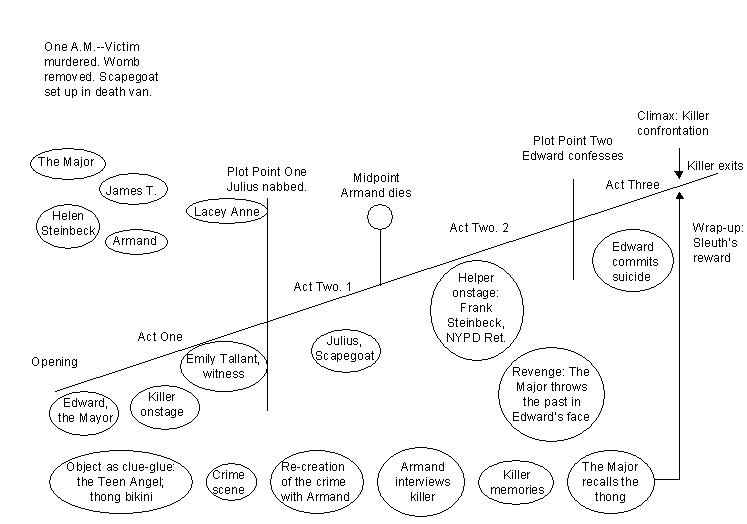
(click to enlarge)
Now indicate approximately where the major characters (killer, victim, sleuth, catalyst) enter for the first time (called "onstage"). This is where you will create a defining picture of each. Also note where they exit. (From their description it sounds like the authors mean exit a scene, but in their diagram they note when characters make permanent exits from the book, eg, die.)
Note, as each character enters, they bring with them their own agenda to the story. They each have something they want that may clash with what the sleuth wants or what other characters want. So, as each character enters, this is the chance for a new scene. A scene is where the immediate goal, the point of what ensues changes. That is, the sleuth may be finding out about the movements of the murder victim and then the murder victim's mother enters with her own agenda. That can signal a shift in the point of what follows. Create a vivid name for each of these scenes.
Then attach any minor characters you've created.
If time in the story is important, note that. Show the passage of hours, days, weeks, months, years. Whatever pace it is your story is unfolding in. If your sleuth is injured on day 1, you'll have a visual cue of how far into your story that will still be a factor.
If there's a particular object that's key to solving the murder, the authors suggest noting along the plot line where it surfaces (physically or in someone's recollections) throughout the story. Since their diagram was crowded, they put notes across the bottom, each lining up with the point where they will occur during the story.
Generating Scenes
If the diagram has gotten too full, the authors suggest creating a second one. Put the character entrances on and then note the scenes, with their vivid names, along the rising action line.
Make a scene card for each new scene you've created. Add any new information, such as how one scene connects to another, to any scene cards you created previously.
Thursday, December 14, 2006
CAT TOWN THEATER

HELLO, I'M ANGEL, HERE TO INTRODUCE YOU TO CAT TOWN. CAT TOWN IS A TOWN WHERE EVERYBODY IS A CAT AND THERE ARE MANY HILARIOUS ADVENTURES.

I'M EL GUAPO, THE HERO OF MANY CAT TOWN TALES. AND YOU, TOO, CAN ADD TO THE MERRIMENT BY WRITING YOUR OWN EPISODE (PREFERABLY IN ALL CAPS BECAUSE THAT'S THE WAY WE TALK IN CAT TOWN.)

MAYOR SAILOR SUIT CAT. YOU MUST CHECK OUT THE RESIDENTS OF CAT TOWN SO YOU KNOW WHO YOU'RE WRITING ABOUT.

I'M LITTLE REDHAIRED CAT WHO IS IN LOVE WITH EL GUAPO. I'M QUITE CERTAIN EPISODE 1 WILL GET YOU INSPIRED. AND SEVERAL EPISODES WILL GET YOU EVEN MORE INSPIRED. SOON YOU WILL WRITE AND TALK LIKE WE DO IN CAT TOWN!
Note: If Cat Town Theater disappears, try the Cat Town mirror site.
Sunday, October 01, 2006
Top Ten Tabloid Headlines for October 2006
 From The City Newsstand's (a newsstand/bookstore in Chicago) monthly MAGBAG -- Top 10 Tabloid Headlines. (Mostly from Weekly World News (WWN) and the SUN.)
- FATAL FARTS! — WWN
- GRANNY SCARES OFF ROBBERS BY PULLING A BIGGER KNIFE! — SUN
- SATAN CAPTURED BY GIs IN IRAQ! — WWN
- VAMPIRES ATTACK U.S. TROOPS Army of undead taking over mountains of Afghanistan! — WWN
- VEGAN VAMPIRE ATTACKS TREES — WWN
- Sherriff serves up a bowl of his own blood as bait to capture... VAMPIRE CAT! — WWN
- Mystery of the floating coffin — SUN
- SCIENTISTS END TERROR OF THE WALKING MUMMY! — SUN
- AMERICA'S LATEST ILLEGAL IMMIGRANTS — VAMPIRES — SUN
- JUDGE WHO BARRED WITCHES FROM ADOPTING CHILDREN TURNED INTO GUINEA PIG! — WWN
Subscribe to:
Posts (Atom)