Saturday, September 30, 2006

Freewriting to character building

dancer.jpgUse free writing to build characters.

Make a list of emotions. Each day free write for 15 minutes -- that is write without pausing, push the ideas out -- about what your character thinks about the emotion, what emotions it elicits for him, experiences he's had with it in himself and in others. Anything and everything that flows out nonstop for 15 minutes.

There are several lists of emotions on the internet. The one here is from Basic emotions - list of emotions.

Wikipedia also has a list of Emotions.

And at Burning Void: Passion (though some seem more akin to characteristics).

(From an idea posted by Sesselja on the National Novel Writing Month (NaNoWriMo) forums.
love
compassion
sentimentality
lust
passion
infatuation
longing
joy
satisfaction
ecstasy
enthusiasm
zeal
thrill
contentment
pleasure
pride
triumph
optimism
rapture
relief
amazement
aggravation
frustration
anger
hostility
hate
scorn
vengefulness
resentment
disgust
jealousy
torment
suffering
depression
sadness
grief
disappointment
guilt
shame
remorse
alienation
loneliness
insecurity
embarrassment
humiliation
insult
pity
sympathy
shock
fear
panic
anxiety
dread

Thursday, September 28, 2006

Words of the Year

tsunami.jpgOnly three months away from this year's list but I just came across this: Merriam-Webster OnLine posted a list of top searched words of 2005.

(There are links to definitions there. But feel free to make up your own definitions.)

Use them as a 10-15 minute writing prompt (story or poem).
integrity
refugee
contempt
filibuster
insipid
tsunami
pandemic
conclave
levee
inept

Tuesday, September 26, 2006

Wanted!

Wanted_For_Lincoln_Assassin.gifCreate a Wanted poster for a notorious criminal. Make up an evil person, use your favorite evil character, or write the Wanted poster the bad guys would put up for a pesky good guy they want eliminated.

If you need some inspiration, there are some real wanted posters at FBI's Most Wanted. They are, of course, not nice people being very not nice currently so not for the faint of heart.

There are some Wanted posters from the old west at Outlaws of the American West. Who were also not nice people but at least they're long dead.

One at Wikipedia for John Wilkes Boothe. (A longer version of the picture at right.) There's also a bigger version that you can read the smallest print if you don't mind waiting for it to load.

And some Wanted posters for bugs at Bug Mugs :-)

Sunday, September 24, 2006

Dragon Writing sticks

Here's the list of words that I used for the writing prompt -- though more of a game really! -- in the Dragon Writing fun shop at the Live and Learn Conference. (Click on Comments at the bottom of the post for a list of the words.)

For those who weren't there, I had a whole bunch (maybe 300) colored popsicle sticks with words written on both sides. We drew a bunch of sticks and tried to come up with fantasy tabloid headlines.

The only instruction I gave was to choose 2 sticks of each color. That just gives you a good mixture of word types to start working with. You don't need to use them all. You don't need to use each color. You can throw back and redraw any that aren't working and draw whatever color. Whatever helps!

I used two packs of colored popsicle sticks and put words on each side. I can't remember how many were in each pack. (150 maybe?)

Plain - Conjunctions and Prepositions. These are the only ones that have 4 to a stick. Katelyn came up with this idea in the headlines she sent to the list and it seemed to make them more interesting. I went through the newspaper and kept track of the prepositions that were most common. There are multiple copies of each set. Katelyn needed an "on" a couple of times so I made one but it's all by its lonesome at the moment. There's a list of prepositions at Test Magic. Way more than the newspaper headlines ever use! ;-)

Green - Places and Objects. Probably the least useful category but interesting to have.

Red - Verbs. There are more words than I had sticks for so I colored some plain sticks with a red marker.

Blue and Purple - People and Creatures. Probably the most useful category since the nouns can often do double duty as adjectives: vampire astrologist for instance.

Yellow and Orange - Adjectives. If I were doing it again, I would change what adjectives I could to nouns, like "baby" for instance. (Especially since I had extra blue and purple and ran short of yellow and orange so had to make some.)

Using colored sticks isn't important. It's just less annoying. My daughter and I have another set of just plain sticks with random words on it originally intended to generate manga-ish story ideas. They've expanded beyond that (a recent one had something to do with a local radio personality and sparkly pants ;-) But since they're all the same color, it's annoyingly easy to pull out a whole series of nouns as you search for a verb.

I don't know if it makes a difference but, as I was writing them, I had the words printed in two columns (4 columns for the adjectives) and chose the word for one side of a stick from column A and the other side of the stick from column B so all the "a"s, for instance, weren't clustered onto the same sticks. As I said I'm not sure if it makes a difference but it seemed to make sense at the time!

Thursday, September 21, 2006

Killing ways

Pouncing_Puma.jpgWrite 35 (or more!) *ways* for a character to murder another. Again, push it even if they start sounding wacky. Try doing one or more for each letter of the alphabet. It might knock some more ideas loose!

Tuesday, September 19, 2006

Aliens ate my antenna

Aliens Ate my Radio.jpgWrite an alliterative (tabloid if you wish) headline for each letter of the alphabet.

Saturday, September 16, 2006

Hack your way out of writer's block

Monkey.jpgHack Your Way Out of Writer's Block

by Merlin Mann
I recently had occasion to do some…errr…research on writer’s block. Yeah, research. That’s what I was doing. Like a scientist.

I found lots of great ideas to get unstuck and wrote the best ones on index cards to create an Oblique Strategies-like deck. Swipe, share, and add you own in comments.
  • Talk to a monkey - Explain what you’re really trying to say to a stuffed animal or cardboard cutout.

    [Joyce: This is a variation of the classic "What Am I Really Trying To Say?" Sometimes we get so lost in the details of the trees that we can't see the forest we're trying to write about. You can also try explaining your story to a friend in an email. (You don't need to send it.)]

  • Do something important that’s very easy - Is there a small part of your project you could finish quickly that would move things forward?

    [Joyce: In Bird by Bird, Anne Lamont suggests looking at a project one piece at a time. "Bird by bird" as her father suggested to her brother when he had to write a report about birds. A novel can be intimidating but you've "assigned" yourself just to write a description of the main character, that seems more doable.]

  • Try freewriting - Sit down and write anything for an arbitrary period of time—say, 10 minutes to start. Don’t stop, no matter what. Cover the monitor with a manila folder if you have to. Keep writing, even if you know what you’re typing is gibberish, full of misspellings, and grammatically psychopathic. Get your hand moving and your brain will think it’s writing. Which it is. See?

  • Take a walk - Get out of your writing brain for 10 minutes. Think about bunnies. Breathe.

  • Take a shower; change clothes - Give yourself a truly clean start.

  • Write from a persona - Lend your voice to a writing personality who isn’t you. Doesn’t have to be a pirate or anything—just try seeing your topic from someone else’s perspective, style, and interest.

  • Get away from the computer; Write someplace new - If you’ve been staring at the screen and nothing is happening, walk away. Shut down the computer. Take one pen and one notebook, and go somewhere new.

  • Quit beating yourself up - You can’t create when you feel ass-whipped. Stop visualizing catastrophes, and focus on positive outcomes.

  • Stretch - Maybe try vacuuming your lungs too.

  • Add one ritual behavior - Get a glass of water exactly every 20 minutes. Do pushups. Eat a Tootsie Roll every paragraph. Add physical structure.

  • Listen to new music - Try something instrumental and rhythmic that you’ve never heard before. Put it on repeat, then stop fiddling with iTunes until your draft is done.

  • Write crap - Accept that your first draft will suck, and just go with it. Finish something.

    [Joyce: Pretty much the idea behind National Novel Writing Month. When the goal is to write 2000 words a day then what you write becomes less important than just getting words down on the page. And it's amazing the stuff that comes out when the inner editor is on vacation.]

  • Unplug the router - Metafilter and Boing Boing aren’t helping you right now. Turn off the Interweb and close every application you don’t need. Consider creating a new user account on your computer with none of your familiar apps or configurations.

  • Write the middle - Stop whining over a perfect lead, and write the next part or the part after that. Write your favorite part. Write the cover letter or email you’ll send when it’s done.

    [Joyce: Another idea is to write something outside of the story: background of a character, a letter from one character to another.]

  • Do one chore - Sweep the floor or take out the recycling. Try something lightly physical to remind you that you know how to do things.

  • Make a pointless rule - You can’t end sentences with words that begin with a vowel. Or you can’t have more than one word over eight letters in any paragraph. Limits create focus and change your perspective.

  • Work on the title - Quickly make up five distinctly different titles. Meditate on them. What bugs you about the one you like least?

  • Write five words - Literally. Put five completley random words on a piece of paper. Write five more words. Try a sentence. Could be about anything. A block ends when you start making words on a page.

Thursday, September 14, 2006

Time to kill

body-outline.gifWrite 35 motives for why a character would want to murder another. Push it even if they start sounding wacky.

If you want, take the third-last item you wrote and use that as a writing prompt for 10-15 minute.

From the writing prompts at OnceWritten.com.

Tuesday, September 12, 2006

The Famous Wombat Specter

wombat_screaming.jpgChoose a hero and a villain. Set the timer for 10-15 minutes and write their latest encounter.

THE SUPER HEROES

The famous Wombat Specter
Power(s): Dark generation/control, Precognition
Source of powers: Solar
Weapon: Light Derringer
Transportation: Meteor Ornithopter

The fearless Cyberfly
Power(s): Insect control, Super intelligence
Source of powers: Abnormal brain function
Weapon: Ether Throwing Stars
Transportation: Ring Portal

The lucky Dragon Princess
Power(s): Sharp shooting
Source of powers: Electrocution
Weapon: Force Missiles
Transportation: Vibro Forklift

The wondrous Tiger Light
Power(s): Dark generation/control, Prehensile tail
Source of powers: Raised by animals
Weapon: Kryptonite Sword
Transportation: Tomorrow Tractor

THE SUPER VILLAINS

The deadly Ghost Whatsit
Power(s): Super strength, Juggling, Extra-dimensional travel
Source of powers: Radiation
Weapon: Omnithrowing stars
Transportation: Insect Skates

The socio-pathic Fire Warrior
Power(s): Matter consumption, Radiation generation/control
Source of powers: Evolved artificially
Weapon: Silver Bazooka
Transportation: Cosmic Rhino

The maniacal Phantom Weirdo
Power(s): Illusion casting
Source of powers: Soul sold to Devil
Weapon: Foam Tentacles
Transportation: Ant Warhorse

The abhorrent Android Rage
Power(s): Autonomic function control, Super-human weight-guessing accuracy
Source of powers: Demonic
Weapon: Slime Sling
Transportation: Wingwing

These were randomly generated super heroes and super villains at Lee's (Useless) Superhero Generator.

Thursday, September 07, 2006

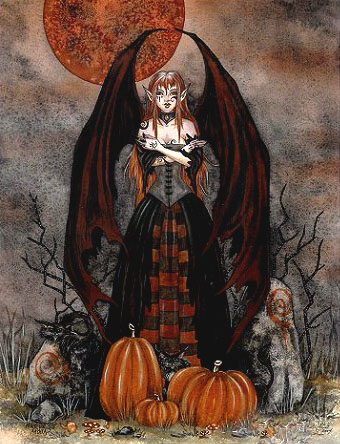
Harvest Moon

harvestmoon.jpgIt's the harvest moon and she's agreed to pose for a portrait. Who is she?

(Click the image to open a larger one in a new window from Amy Brown's website. Or here if she's moved her pictures again and the link doesn't work.)

Wednesday, September 06, 2006

Include this sentence

barleygrass.jpgWrite a story that contains one of these sentences.

To get started, try writing the sentence down on your page and continuing from it. Then if you find you need to build up to the sentence for the story to make sense, add sentences before it.
  • Winds seem horrible even though they are absent.
  • Families look dim despite the fact that they are old.
  • Brains will be content wherever anger arises.
  • Friends appear important as long as they are determined.
  • Skies could be inefficient until they find contentment.
  • Enthusiasts feel incompetent when they are doing what must be done.


Sentences generated at Writing Fix's First Sentence Creator: Deep Thoughts.

Saturday, September 02, 2006

100 sentences

epiphany.jpg I'm going to collect some "writer's block" tips. I don't like the term writer's block. It sounds like a disease that will stay with you until find a cure. Which only turns it into something worse than it is.

Stuck. Stalled. The point is to get moving again, often by doing something different, or off in a different direction rather than sitting there spinning your tires.

This is an idea from 3AM Epiphany, a book of writing exercises by Brian Kiteley.

He suggests writing 100 sentences about a character you're stuck on. Or a place. Or a setting. Or an Idea. Don't lift your fingers from the keyboard through the whole exercise. Let it sit for a day and then revise.

100 *short* -- he lists the exercise as 800 words total -- sentences. (Though 200 or 500 sentences he thinks would be even better but 100 is enough to be useful.) They shouldn't connect. He says just relax and let your mind flow free to find new material. "It is unnerving to have to write so many sentences in a row, and after a certain point the pressure of creating character details overcomes the pressure to tell a story."

Friday, September 01, 2006

Top 10 tabloid headlines for September 2006

WWNStrangeBreedOfCat.gifFrom The City Newsstand's (a newsstand/bookstore in Chicago) monthly MAGBAG -- Top 10 Tabloid Headlines. (Mostly from Weekly World News (WWN) and the SUN.) 
  1. JACK THE RIPPER WAS A WOMAN! — SUN
  2. STUDIO BUYS MOVIE SCRIPT FROM A CHIMP! — WWN
  3. RESEARCHER CALCULATES A SNOWBALL'S CHANCE IN HELL TO BE .000000000134% — WWN
  4. Michael Jackson wants to live with leprechauns — SUN
  5. MICROSCOPIC SPACE ALIENS INFESTING CARPETS — WWN
  6. UFO ALIENS ABDUCTED MY CAT! Now frisky Felix is home safe — and has a gift of ESP, says amazed owner — SUN
  7. BARBER BLEEDS RED & WHITE STRIPED BLOOD! — WWN
  8. SPEND IT WHILE YOU CAN! U.S. currency accidentally printed with disappearing ink! — WWN
  9. ASTRONOMER DISCOVERS PLANET MADE ENTIRELY OF NOODLES — WWN
  10. CREDIT CARD EXPLODES WHEN GAL GOES OVER LIMIT! — WWN

Thursday, August 31, 2006

Spiked beast

spikedbeast.jpgUse the following in sentences or a paragraph or a story. They don't need to be in the order given this time. (But of course you can if you want!)
  1. spiked, beast, evaded, eager, unfriendly, fairy, fierce
  2. liver, sly, twisted, wander, competition, laugh, giant
  3. spare, horse, sick, bubbly, baboon, book, crockery
  4. shapeshifter, modified, cavern, brain, typical, crafty, squealed
  5. invent, stuffy, overgrown, talons, moldy, tournament, amazing
(The original photo is even cuter. You can click on it if you want to see. :-)

Wednesday, August 30, 2006

Not quite an argument

dog.jpgReveal character and past and relationship through dialogue with two characters arguing. They should both be convincing since they each feel strongly that they're right. You can choose from these ideas or come up with your own:
  • dog who can speak arguing over why he won't be sleeping on the floor anymore
  • a child who wants to go to wizard school rather than stay in the family business.
  • a couple arguing over whether to stay on planet or move to a new primitive colony.
  • two beings of different races/species, arguing with their families/villages over a partnership the two want to form
  • a young person who has awakened a magical power for thievery but just wants to be a good person, arguing with her grandfather who wants to train her in the family tradition
  • an android arguing with it's owners over it's right to be free and independent
From What If?: Writing Exercises for FIction Writers by Anne Bernays and Pamela Painter

Saturday, August 26, 2006

How To: Quit Your Day Job

hollylisle.jpgHolly Lisle has, in addition to 30 fantasy and science fiction (and other genres) novels, compiled a wealth of essays on writing. (Some of her out of print books are available from her site for free download also.)

Here's a bit from her Middles essay:
I'm in one right now --- a middle, that is. Actually, I'm nearing the end of the middle, which in my humble opinion is the utter worst place in the universe to be.

The loathsome middle in question happens to be in Curse of the Black Heron, but it wouldn't matter. I've never met a middle I liked, and if the middle weren't CotBH, it would be something just as bad, or worse.

Writers come in all sorts. There are folks who dread the blank page, and who have an absolute terror of getting the thing started, but once they've been plugging on a bit, they're fine. There are folks who start well, middle well, and hate endings. And then there's my sort --- we who start well and end well (or at least enjoy doing our beginnings and endings, which I admit isn't always the same thing) but who do awful things to ourselves in the middle of every book because halfway through, we're certain that whatever magic we once had is gone and that every word that spills from our fingertips onto the keyboard has become total crap.
Here's a sampling:

HOW TO'S
  • Quit Your Day Job
  • Format a Manuscript
  • Start a Novel
  • Create a Character
  • Finish A Novel
  • Revise A Novel
  • Collaborate
  • Design a Career
  • Steal Ideas
  • Fantasy
  • SF Worldbuilding
  • Time & First Person

WORKSHOPS
  • Creating Conflict
  • Novel Pre-Writing
  • Set Writing Goals
  • Character Creation
  • Dialogue
  • Maps
  • Scene Creation
  • Timed Writing
  • Worldbuilding
  • Pacing Scenes
  • Plot Outline
  • Fast Plotting
  • Visualization
  • Characterization
  • Using Strangeness
  • Honing Your Talent
  • Write Suckitudinously
  • Evaluate Your Work
  • Description
  • One-Pass Revision
  • Revising Vincalis

Thursday, August 24, 2006

Alphabetical actions

sunrise.jpgAdverbs and adjectives can be useful but sometimes they're used to prop up weak nouns and verbs, like "ran quickly" and "walked slowly". Much better is dashed, bolted, darted, whipped ... and strolled, sauntered, wandered ...

For the following sentence, for each letter of the alphabet, write down a strong verb -- or several strong verbs -- that captures the essence of the night/moon/darkness leaving and the day/sun/light arriving. Dare to come up with bad writing :-) Bad is fun and loosens creativity. Some will change the flavor -- vanquished? -- but still get at the same idea. You can switch it around and make the darkness the subject (the active one) rather than the sun.

"The sun washed away the darkness."

Tuesday, August 22, 2006

Your own superhero

Jantzy.jpgCreate your own superhero at Superhero game at Scifi.com and then write about them: a typical adventure, an origin story, the final showdown ...

(Hint: I went through the whole process choosing items in black and white. It's lots easier to see the choices if you color them first! ;-)

Saturday, August 19, 2006

Periodic Table of Science Fiction

periodchart.gifAnd here it is. Michael Swanwick's Periodic Table of Science Fiction. 118 short short stories, each involving an element from the periodic chart. Very clever!

Thursday, August 17, 2006

In Loco Parentis

iodine.jpgHere’s another short short story from Michael Swanwick’s collection to write the ending for. I’ll put up a link to the collection on Saturday.
Iodine
In Loco Parentis

It was all done in the name of security, of course. My security, your security, national security … it hardly made any difference which. Smoking was banned from public places. Motorcyclists had to wear helmets. Drivers were required to wear seat belts. Airline passengers couldn't carry nail clippers. Pregnant women weren't allowed to drink. Hardware clerks had to submit to random drug testing.

Some of these laws made sense, of course. Others did not. But they all added momentum to the slow erosion of liberty, and then to the rapid erosion of liberty, and then to the redefinition of liberty as a threat to Our Way of Life. Everyone was required to carry ID cards with their gene-print and retina scan. Contact sports were banned. Distressing news was kept out of the media. Walls were built at every border. International travel was halted. Government finkware was installed in all new computers.

The day dawned when everyone's existence was finally safe. Free of danger, violence, sex, or human contact. Free of hate or envy or jealousy or lust or even love. Nothing new or unexpected ever happened. One day was much the same as another.

...

Tuesday, August 15, 2006

A Beryl as Big as the Ritz

beryl.jpgOne classic writing exercise is to read half of a short story and then write the ending you'd like to see happen. Then read the rest and see which ending you like better. (You can do this with TV shows too. Think about what you would have happen next if you were the writer.)

Here's something to try it out on that's in keeping with the 10-15 minute nature of the prompts here. Michael Swanwick has created a short short story for each element on the periodic chart, The Periodic Table of Science Fiction. This is about half the story. Where would you take it?
Beryllium
A Beryl as Big as the Ritz

On the Gem Planet, the rarest and most valued of all substances is dirt. Just the scrapings from beneath a hobo's nails would bring enough to support him for a year.

Across the desert plains of sheer diamond wealthy tourists come. They wear slitted goggles to protect themselves from the blinding reflections of the sun. There is a red glint ahead. That is their goal.

Hexagonal in cross-section, it is the largest outcrop of pure beryl on the planet. Artisans have carved rooms into it, with fluted columns and elaborate fireplaces, and there are banquet halls and ballrooms as well. At the break of day, when the sun shines through the Ruby Mountains and dawn lases across the plains, the guests are escorted to basement safe-rooms carved from darkest emerald. Even there, the walls glimmer elegantly.

But it is not beauty that brings visitors to the Ritz-Beryllium. Beauty, for them, is so common as to be invisible.

....

Saturday, August 12, 2006

101 Writing tips

chocolateteapot.jpg101 Writing Tips

by Prof. D. J. Higham
Department of Mathematics
University of Strathclyde

(These are all original, but some are based on old jokes.)
  1. Every sentence should make sense in isolation. Like that one.
  2. Excessive hyperbole is literally the kiss of death.
  3. ASBMAETP: Acronyms Should Be Memorable And Easy To Pronounce, and SATAN: Select Acronyms That Are Non-offensive.
  4. Finish your point on an up-beat note, unless you can't think of one.
  5. Don't patronise the reader-he or she might well be intelligent enough to spot it.
  6. A writer needs three qualities: creativity, originality, clarity and a good short term memory.
  7. Choose your words carefully and incitefully.
  8. Avoid unnecessary examples; e.g. this one.
  9. Don't use commas, to separate text unnecessarily.
  10. It can be shown that you shouldn't miss out too many details.
  11. Similes are about as much use as a chocolate teapot.
  12. Avoid ugly abr'v'ns.
  13. Spellcheckers are not perfect; they can kiss my errs.
  14. Somebody once said that all quotes should be accurately attributed.
  15. Americanisms suck.
  16. Capitalising for emphasis is UGLY and DISTRACTING.
  17. Underlining is also a big no-no.
  18. Mixed metaphors can kill two birds without a paddle.
  19. Before using a cliché, run it up the flagpole and see if anybody salutes.
  20. There is one cheap gimmick that should be avoided at all costs..............suspense.
  21. State your opinions forcefully-this is perhaps the key to successful writing.
  22. Never reveal your sources (Alistair Watson, 1993).
  23. Pile on lots of subtlety.
  24. Sure signs of lazy writing are incomplete lists, etc.
  25. Introduce meaningless jargon on a strict need-to-know basis.
  26. The word ''gullible" possesses magic powers and hence it should be used with care.
  27. The importance of comprehensive cross-referencing will be covered elsewhere.
  28. Resist the temptation to roll up the trouser-legs of convention, cast off the shoes and socks of good taste, and dip your toes refreshingly into the cool, flowing waters of fanciful analogy.
  29. Don't mess with Mr. Anthropomorphism.
  30. Understatement is a mindblowingly effective weapon.
  31. Injecting enthusiasm probably won't do any harm.
  32. It is nice to be important, but it is more important to avoid using the word 'nice.'
  33. Appropriate metaphors are worth their weight in gold.
  34. Take care with pluri.
  35. If you can't think of the exact word that you need, look it up in one of those dictionary-type things.
  36. Colons: try to do without them.
  37. Nouns should never be verbed.
  38. Do you really think people are impressed by rhetorical questions?
  39. Pick a font, and stick with it.
  40. Sufficient clarity is necessary, but not necessarily sufficient.
  41. Less is more. This means that a short, cryptic statement is often preferable to an accurate, but drawn out, explanation that lacks punch and loses the reader.
  42. Sarcasm-yes, I bet that will go down really well.
  43. The problem of ambiguity cannot be underestimated.
  44. Never appear cynical, unless you're sure you can get away with it.
  45. Many writer's punctuate incorrectly.
  46. Colloquialisms are for barmpots.
  47. There is a lot to be said for brevity.
  48. To qualify is to weaken, in most cases.
  49. Many readers assume that a word will not assume two meanings in the same sentence.
  50. Be spontaneous at regular intervals.
  51. The era of the euphemism is sadly no longer with us.
  52. Want to be funny? Just add some exclamation marks!!!
  53. Want to appear whimsical? Simply append a smiley ;-)
  54. Some writers introduce a large number, N, of unnecessary symbols.
  55. Restrict your hyphen-usage.
  56. Choosing the correct phrase is important compared to most things.
  57. Some early drafts of this document had had clumsy juxtapositions.
  58. Try not to leave a word dangling on its own
    line.
  59. The number of arbitrary constants per page should not exceed .13.
  60. Use mathematical jargon iff it is absolutely necessary.
  61. And avoid math symbols unless $ a good reason.
  62. Poor writing effects the impact of your work.
  63. And the dictionary on your shelf was not put there just for affect.
  64. If there's a word on the tip of your tongue that you can't quite pin down, use a cinnamon.
  65. If somebody were to give me a pound for every irrelevant statement I've ever read, then I would be very surprised.
  66. Strangely enough, it is impossible to construct a sentence that illustrates the meaning of the word 'irony.'
  67. Consult a writing manual to assure that your English is correct.
  68. It has been suggested that some words are absolute, not relative. This is very true.
  69. Be careful when forming words into a sentence-all orderings are not correct.
  70. Many words can ostensibly be deleted.
  71. In your quest for clarity, stop at nothing.
  72. Complete mastery of the English language comes with conscientious study, notwithstanding around in bars. Moreover the next page. Inasmuch detail as possible.
  73. Sporting analogies won't even get you to first base.
  74. If you must quote, quote from one of the all-time greats (Cedric.P. Snodworthy, 1964).
  75. In the absence of a dictionary, stick to words of one syllabus.
  76. Steer clear of word-making-up-ism.
  77. Readers will not stand for any intolerance.
  78. If there's one thing you must avoid it's over-simplification.
  79. Double entendres will get you in the end.
  80. Vagueness is the root of miscommunication, in a sense.
  81. Don't bother with those ''increase-your-word-power" books that cost an absorbent amount of money.
  82. Self-contradiction is confusing, and yet strangely enlightening.
  83. Surrealism without purpose is like fish.
  84. Ignorance: good writers don't even know the meaning of the word.
  85. The spoken word can look strange when written down, I'm afraid.
  86. Stimpy the Squirrel says ''Don't treat the reader like a little child."
  87. Intimidatory writing is for wimps.
  88. Learn one new maths word every day, and you'll soon find your vocabulary growing exponentially.
  89. My old high school English teacher put it perfectly when she said: ''Quoting is lazy. Express things in your own words."
  90. She also said: ''Don't use that trick of paraphrasing...... [other people's words]...... inside a quote."
  91. A lack of compassion in a writer is unforgivable.
  92. On a scale of 0 to 10, internal consistency is very important.
  93. Thankfully, by the year 2016 rash predictions will be a thing of the past.
  94. There is no place for overemphasis, whatsoever.
  95. Leave out the David Hockney rhyming slang.
  96. Bad writers are hopefully ashamed of themselves.
  97. Eschew the highfalutin.
  98. Sometimes you publish a sentence and then, on reflection, feel that you shouldn't ought to have been and gone and written it quite that way.
  99. Practice humility until you feel that you're really good at it.
  100. If there's a particular word that you can never spell, use a pnemonic.
  101. A strong ending is the last thing you need.
  102. Make sure that your title is accurate.
  103. Spelling dictionaries should be made compulsary.
  104. Sometimes, a foreign phrase can add a little 'je ne sais rien.'
  105. In terms of writing convoluted sentences, don't.
  106. Let's face it, we all hate it when a writer appeals to the lowest common denominator.
  107. Learn the basic spelling rules; don't just rely on fonetix.
  108. Only take writing tips from world-renounced writers.
  109. Writing for the non-native English speaking market is a different kettle of fish.
  110. If you can't afford a book on grammar, at least find someone to lend one off.
  111. Nothing is worse than ambiguity.
  112. Oh, and avoid afterthoughts.

Thursday, August 10, 2006

Cursed

camel.jpgPick one of the following. Set the timer for 10-15 minutes and tell what happened after the curse. Did the curse come to pass exactly as pronounced? Was the universe twisting the caster's words? Did the character manage to change the curse?
  • Hear this, O ye exceedingly foolish virgin, for you will be kicked by an incontinent camel!
  • Behold, thou shalt be trampled by a herd of stampeding pigs, O thou wolf in sheep's clothing!
  • Thou shalt be taunted by the king's concubines, O thou love-crazed Gittite!
  • Harken, O thou relative of Herod, for you will beget difficult teenagers!
  • Woe unto thee, O ye relative of Herod, for you will be cast onto a steaming dung-heap!
  • Take heed, O thou who art a byword for idiocy, for you will be swallowed by a whale with excessively bad breath!

From Biblical Curse Generator

Tuesday, August 08, 2006

Executioner baby explodes 340 pound vampire

Explosion Photo.jpgCreate newspaper headlines using the words from the list. Try to use at least five of the words in each headline. (Feel free to add some words like "in", "on", "after", "and" ...)

If you want, print out the words, cut them up and draw from the pile until you come up with headlines you like. (You can reshuffle them after each headline.)
blind
accused
fights
dragon slayer
monastery
temple
charms
exiles
crumbling
crooked
baby
executioner
explodes
bizarre
blasphemous
340 pound
warrior
corrupt
sarcophogus
palace
proves
quests for
vampire
tomb
shames
rips off
destroys
fairy
curses
barbarian

Saturday, August 05, 2006

Getting off the starting line

olympic-starting-line.jpgThis was posted by Arathe on the National Novel Writing Month (NaNoWriMo) forums. I haven't planned out either of the stories I used for NaNoWriMo. The time pressure seems to force the ideas to come out. But without that time pressure, when you're staring at a blank screen, planning can be very helpful! -- Joyce


Getting off the starting line by Arathe

Well, I just sat down today to start working on my plot for this year's NaNo. I attribute my lack of success in earlier years to my lack of planning. Trying to throw something together two weeks before go-time just doesn't cut it for me. ;)

So, I plan on giving myself a lot of time to plan and tweak this year. Unfortunately, I have no ideas, no plot, no characters, nothing! All is not lost, however! I have a little trick for finding a good jumping-off point that I'd share with everyone else out there who are having a hard time finding that elusive plot this year.

1. Pick your genre.

A bit obvious, perhaps, but deciding on a genre will give you a bit of direction. I'll pick Fantasy.

If you can't pick a single genre, at least try to narrow the list down as much as possible and move on to step 2.

2. Make a list of concepts that you like.

- This should naturally try to stay within the bounds of the genre(s) you chose. Spaceships, for example, might not be a good choice when you've decided on Fantasy. Likewise, Evil Magician might not be the ideal choice for your contemporary murder mystery.

- The list can be as long as you like. The longer, the better. You'll find that the longer the list gets, the more unique and interesting your ideas become. Someone who's name I can't recall at the moment said once that the first five or ten ideas on a list are throwaways. It is in those that you'll find your most common ideas, your cliches. The farther down the list you go, the more you have to stretch your imagination, and the more original and interesting those ideas will be.

Which isn't to say you shouldn't use the ideas on the top of your list. The point of this exercise is to find something you're excited about, something you WANT to slave away at for a month. The important part is getting it done. Being innovative or original comes second to that.

Some examples for my Fantasy genre:

- Gods in mortal form.
- Corrupt religion
- Shapeshifters
- Demons
- Taboo magic
- Magic as science

This is only a sample of course, my list will be much longer when I finish it, as yours should be. I'd suggest a list of at least twenty concepts that appeal to you.

3. Circle the concepts that appeal to you most.

- Choose anywhere from 2-10 concepts on your list that jump out at you. The exact number can vary, depending on how many you really like and how long your list is.

4. Write a one sentence plot summary based around each of the circled concepts.

- I want to stress that a single-sentence summary should take you no more than five minutes each. You're brainstorming here. If you find yourself unable to come up with something within five minutes, move on to the next concept on your list and come back to it later.

- Feel free to merge two or more concepts into a single plot summary if it strikes your fancy. If you can't fit it all into one sentence, don't worry; you'll get the chance to expand on it in the next step.

- If you have more than one idea for a sentence summary for a single concept, go for it! Write as many as you feel like. This part of the process isn't limited to once concept, one sentence. Keep going for as long as you can. The more you have when you're finished, the more you'll have to choose from.

Example summary from my list above:

"A God, imprisoned in mortal form by his sister, seeks a way to free himself and exact his revenge."

Okay, I know that isn't going to win any awards, but it gives you an idea of what I'm talking about. Don't worry about quality here; you're simply trying to churn out as many of these as you can. You can always tweak later.

Another example using the same concept merged with another:

"In a world where science and magic are one, where mystery, mysticism and religion are disdained and ignored lives a boy, the living incarnation of a god old and forgotten, whose emergence into the world once again will send the lives of all who encounter him spinning out of control in ways no one could imagine."

Much better than the first one, even if I cheated a bit and made an awfully long sentence there. It's okay if you fudge the rules a bit, the important thing is the end result. See how I took two concepts, "Gods in mortal form" and "Magic as science" and slapped them together into one idea?

5. Pick any of your single-sentence summaries and turn it into a single-paragraph summary.

- Try to incorporate your sentence into the paragraph.

- This should read a bit like the blurb on the back of a novel might.

- You can do this with as many of your sentences as you like. I can almost guarantee there will be a few that won't work for you, so don't feel bad about scrapping them and focusing on the ones you DO like.

- But what if I don't like any of them? Tough cookies. I expect you to pick at least one and make it into a paragraph. You might surprise yourself. Or it might just suck, but honestly, I dare you to do this and come out without a plot bunny that's at least passable. It's amazing what we can dredge out of our own heads when we put our minds to it.

Example paragraph:

"In a world where magic and science are one, where mystery, mysticism and religion are disdained and ignored, lives a boy. He is the living incarnation of a god old and forgotten, though he has no knowledge of the powerful creature residing within him. As he ages, the god begins to emerge, taking him away from home and family, tearing him from everything he knows and loves. He struggles constantly with Other in his mind, as the god himself puts into the works a holy revolution the likes of which the world has never known, changing the lives of countless people, and possibly the world, forever. Caught in the tide of change being wrought by the creature with which he shares his mind and body, the boy fights to hold on to his mind, his sense of self, in a struggle that becomes increasingly difficult and the Other grows stronger.

Will he survive? Or will he find himself crushed beneath the weight of a will so much stronger than his own?"

I cheated again, since it is technically two paragraphs, but since the last bit was really for dramatic emphasis, its okay. Try to keep it to a single paragraph if you can, though.

Once you're finished, take a look through what you've done. I can almost guarantee you'll have at least one workable idea that you want to use. I actually like the idea in the above paragraph. I think I might even use it, hehe. Least if this doesn't help anyone, I may have gotten something from it. ^^

And you're done! Like I said, you should have at least one plot bunny that begs to be expanded upon. From here, you're on your own. Get started on worldbuilding, flesh out characters, at a few more bones to the plot skeleton, whatever you want! You have your starting point. ;)

If this helps anyone, please post here, I'd like to hear about it. ^^

Thursday, August 03, 2006

Best of spam for July 2006

searchlight.jpgSome intriguing odd phrases that almost mean something, names, single words .... It makes me appreciate the people who write spam filters. They have to find patterns in these nonsense generators.

Well, the list used to be here. Now it isn't.

In less than 24 hours there were comments from 3 spammers. I assume the post Technorati picked up the post and that's the route that lead the spammers to the blog but which of the phrases attracted the spambots? And why would they be attracted to spam anyway?

So now they're at Spam-O-Rama.

The human whose name ...

misamisa.jpgClick the picture for a larger version in a new window.
  • Who is she? (Assuming you don't know! Or can come up with an alternate version of who she might be.)
  • What is her relation to the creature behind her?
  • Who and what is the creature?
  • What is its goal?
Take it from there.

Wednesday, August 02, 2006

Top 10 Tabloid Headlines for August 2006

WWNCoverChoice7.jpgFrom The City Newsstand's (a newsstand/bookstore in Chicago) monthly MAGBAG -- Top 10 Tabloid Headlines. (Mostly from Weekly World News (WWN) and the SUN.) 
  1. SENSIBLE PUTTY! — WWN
  2. BOOZE CAN MELT AWAY POUNDS — SUN
  3. 'NOSE HOSE' WILL MAKE TISSUES OBSOLETE! — WWN 
  4. EXPLORER LOCATES ORIGINAL 'COMFORT ZONE'! — WWN
  5. DA VINCI WAS A TIME TRAVELER! — SUN
  6. WAR IN HEAVEN According to the Archangel Michael, female angels led by the powerful Hillaria have revolted . . . — WWN
  7. Demons influencing presidential policy! — WWN
  8. BOY TURNS BELOVED AUNT INTO ROBOT! — WWN
  9. Just when you thought it was safe to go back into the water, along come . . . NAVY ANTS! — WWN
  10. BILLIONAIRE WILLS HIS FORTUNE TO IMAGINARY FRIEND — WWN

Tuesday, August 01, 2006

Cooling off period

japansnowmonkeys.jpgTo chill down from Thursday's writing prompt, create cool breezy phrases or sentences for each letter of the alphabet.

Saturday, July 29, 2006

10 irritants and 10 delights

problems.gifIt's been a while since I posted a Writer's notebook idea ...

Carry a small notebook around with you this week and write down 10 things that irritate you and 10 things that delight you. They don't need to be big things. Stepping on a marble. Dew on a leaf. Stereo that was left at a high volume and blasts you when you turn it on. Oreos on sale.

At the end of the week, choose some and reset them in your favorite genre.

If you joined recently, I've collected past Writer's notebook ideas. (They're in newest to oldest order, so scroll down for an explanation of what a writer's notebook can be.)

(The white cat and lady with the sock make me smile each time I see them so those are the first on my list of delights for the week :-)

Inspired by #9 Mining Memory of What If?: Writing Exercises for Fiction Writers by Anne Bernays and Pamela Painter.

Thursday, July 27, 2006

Heated exchange

balrog.jpgCreate hot and humid phrases or sentences for each letter of the alphabet.

Tuesday, July 25, 2006

Mothers are often mistaken for robots

kos-mos400.jpg Use one or several of the following and set the timer for 10-15 minutes as a writing prompt:
  • Mothers are often mistaken for robots.
  • Heavyweight boxers believe that surfers analyze cockroaches.
  • Cattle mutilators work for the dairy products.
  • Preachers scratch the faces of technicians.
  • Hellspawn are all New Yorkers.
  • Extraterrestials wish to please the janitors.
  • Grandmothers deny that aristocrats evolved from walruses.
  • Rattlesnakes taunt ballet dancers.
  • Monks cleanse the swashbucklers.
  • Ninjas want to rid the world of Neanderthal tribes.
These are sentences randomly generated at The Random Sentence Generator v.1.0. Each time you reload the page there are 10 new sentences.

Saturday, July 22, 2006

Ten Tips on Writing and Creativity

ladywriting-vermeer.jpgby Emily Hanlon
  1. Don’t think. Creating a story or book has little to do with the intellect or language when we first begin. Our best ideas will emerge as a spark or image. Like dreams, they will make little sense. Followed, they will hold the key to the creative unconscious.

  2. Creativity is cyclical. You cannot and will not be creative all the time. What is full must empty and what is empty will fill. Creativity has its own internal rhythms. Learn to listen to yours.

  3. Nothing kills creativity faster than criticism. Don’t share your work-in-progress with people who are critical or those whose opinions leave you vulnerable, no matter how much you love them. Good critiquing should leave you inspired, not deflated.

  4. Learn to distinquish the voice of your Inner Critic from the voice of your Inner Writer. The Inner Critic is not comfortable with the risks demanded by a creative endeavor. By becoming aware of the foul jabber of your inner critic, you can see how your own mind puts up roadblocks to your creativity.

  5. Being a creator is risky business. Don’t underestimate the tremendous emotional and psychic risks the journey demands. Learn to push ahead even when you are afraid. Learn to love the risk.

  6. Don’t be afraid to fail. Every successful creator has failed hundreds of times. Failure is an integral part of creativity. It doesn’t mean you’re wrong or stupid. It only means you’ve uncovered a path or technique that does not work.

  7. Don’t be afraid to write garbage. Every successful writer writes mounds of garbage. Give your work time to percolate. Play the What If game. For example, if you’re writing fiction and a characters is sweet and loving and you’re stuck, have the character mean and hateful. In the world of the imagination, anything can happen.

  8. Nurture your creativity. It is as fragile as a budding flower. Open to the dance. Listen to music that makes you feel like flying. Go for a walk. Laugh with a friend, child or lover. Creativity is about feeling.

  9. Be passionate. Creativity is passionate. Passion is always creative.

  10. Learn your craft. And write, write, write! The more you write, the better you will get. Discipline yourself. Successful writers are disciplined writers.
©Ten Tips on Creativity(sm), Emily Hanlon 1995-2006.

Ten Tips on Creativity(sm) may be be copied and used on other websites only after advising Emily Hanlon. Credit must be given to Emily Hanlon with a link back to her website: thefictionwritersjourney.com

Thursday, July 20, 2006

And they lived happily ever after

pilgrims.jpgWrite a story backwards. Begin with the conclusion and work back to how it all began.

From an exercise at Writing Exercises

Tuesday, July 18, 2006

Randomly described

eyeball.jpgWrite about or define the first word using the 6 words that follow it:
  • crusty -- eyeball, attitude, ooze, stuffy, luxury, crunched
  • private -- skunk, jagged, beast, dragon, market, slippery
  • overhead -- scared, mirror, modified, mask, billion, crockery
  • thief -- brave, shapeshifter, dark, underneath, fatal, crumbling
  • fearful -- guilt, crawled, curly, hidden, shallow, bounce

Saturday, July 15, 2006

Writing Science Fiction and Fantasy

jeffreycarver.jpgJeffrey A. Carver has created Writing Science Fiction and Fantasy. an entire writing course on line for free :-)

He says the course "teaches the fundamentals of storytelling, and includes such topics as getting from idea to story, world building, creating human and alien characters, plot and conflict, style, finishing, rewriting, submitting to publishers, and more."

You can see a list of the topics at Writing Science Fiction and Fantasy Course Outline and a list of the books he's written at Science Fiction Worlds of Jeffrey A. Carver

Looks cool!

Thursday, July 13, 2006

Name that month

grass.jpgCreate new month names. You'll probably have time to create several sets!

===== More =====

Our month names are curiosities, a mixture of gods, emperors and numbers, without much modern meaning. The Japanese only use numbers. In the past, the names were often tied to the seasons (planting, harvesting, strawberry picking, when the ponies shed their shaggy hair) or events for that time of the year.

Here's a translation of the month names from Charlemagne's time:
Winter
Spring
Lent
Easter
Grazing
Plowing
Hay
Harvest
Wood
Vintage
Autumn/Harvest
Holy
Many ancient people had 13 month years, coinciding with the 13 new moons in a year like the Abenaki:
Greetings Maker Moon
Makes Branches Fall In Pieces Moon
Moose Hunter Moon
Spring Season Maker Moon
Sugar Maker Moon
Field Maker Moon
Hoer Moon
Grass Cutter Moon
Cutter Moon
Corn Maker Moon
Leaf Falling Moon
Freezing River maker Moon
Winter Maker Moon
Here's a curious collection from the Aztecs, with 19 months.
Resurrection
Departure of the waters
Slaughtering of dogs
Little Vigil
Grand Vigil
Dry Thing
Meal of Corn and Bean
Little Feast of Lords
Grand Feast of Lords
Little Feast of The Dead
Grand Feast of The Dead
Sweeping
Small Hay
Large Hay
Flamingo
Raising of the Banners
Lowering of water
Shrinking
Empty Days

Tuesday, July 11, 2006

Tripping over hedgehogs

hedgehog.gif Try to get as many of these as you can into a story.
Tripping over hedgehogs
Rise up with fists
Chalice of malice
Fingernails on a chalkboard
Fragments of beings
Shaking off the dust
Afloat in the moonlight
Inspiration through random foolishness
The waltz of life
Unwritten pages